The Three Stages of Spiritual Growth

The following is by Frank Viola author and it’s from his book Jesus Now.

The Bible speaks of three main stages in spiritual development that correspond to our physical development: infancy, childhood, and adulthood.

The first stage is infancy:

So put away all malice and all deceit and hypocrisy and envy and all slander. Like newborn infants, long for the pure spiritual milk, that by it you may grow up into salvation—if indeed you have tasted that the Lord is good. (1 Pet. 2:1-3 ESV)

But I, brothers, could not address you as spiritual people, but as people of the flesh, as infants in Christ. I fed you with milk, not solid food, for you were not ready for it. And even now you are not yet ready, for you are still of the flesh. For while there is jealousy and strife among you, are you not of the flesh and behaving only in a human way? (1 Cor. 3:1–3 ESV)

Infancy is characterized by a kind of helplessness. A baby is totally dependent on her or his parent to provide. This is true both for the infant’s external and internal needs. Just like a baby needs milk, a baby also need endless amounts of compassion and love.

I can remember a friend suggesting that a crying baby should be disciplined. How ridiculous! The infant is simply alerting us to its needs when it cries. There’s a special sensitivity that we give to infants in part because they are so helpless. But as they grow, we increase the level of responsibility we give them.

Following infancy is childhood. Jesus sanctifies us by His Spirit, making us progressively holy in our conduct. So we are first babes in Christ, and then we grow into childhood—or as John put it, the stage of being “young people” in the faith. During this stage, Jesus does His marvelous work of transformation by His Spirit (Rom. 12:1–2).

I am writing to you, little children,

because your sins are forgiven for his name’s sake.

I am writing to you, fathers,

because you know him who is from the beginning.

I am writing to you, young men,

because you have overcome the evil one.

I write to you, children,

because you know the Father.

I write to you, fathers,

because you know him who is from the beginning.

I write to you, young men,

because you are strong,

and the word of God abides in you,

and you have overcome the evil one. (1 John 2:12–14 ESV)

When I was a child, I spoke like a child, I thought like a child, I reasoned like a child. When I became a man, I gave up childish ways. (1 Cor. 13:11 ESV)

Transformation points to the Lord’s role in allowing us to go through trials and tribulations, which are designed to work His character into us. This is the experiential side of the cross.

From a parent’s perspective, this is when maturity is difficult to watch our children go through. Frustration produces growth, but we don’t want our children bouncing from one failure to another. However, a parent who doesn’t allow their kids to risk, stumble, and fall is actually stunting their child’s growth.

Consider it all joy, my brethren, when you encounter various trials, knowing that the testing of your faith produces endurance. And let endurance have its perfect result, so that you may be perfect and complete, lacking in nothing. (James 1:2–4)

In this you greatly rejoice, even though now for a little while, if necessary, you have been distressed by various trials, so that the proof of your faith, being more precious than gold which is perishable, even though tested by fire, may be found to result in praise and glory and honor at the revelation of Jesus Christ. (1 Pet. 1:6–7; see also 1 Pet. 4:12–13)

And not only this, but we also exult in our tribulations, knowing that tribulation brings about perseverance; and perseverance, proven character; and proven character, hope. (Rom. 5:3–4)

Jesus’ present-day ministry of reproving and disciplining us is also included in this stage.

Those whom I love, I reprove and discipline; therefore be zealous and repent. (Rev. 3:19)

But when we are judged, we are disciplined by the Lord so that we will not be condemned along with the world. (1 Cor. 11:32)

Assurance & Correction

The following article is an excerpt from the book Jesus Now by Frank Viola Author

Assurance

Even though I walk through the valley of the shadow of death, I fear no evil, for You are with me …

In every grueling trial, in every dark night, in every unexpected crisis, our good shepherd promises to be with us. Therefore, we have nothing to fear.

All throughout the Bible, God tells His people to “fear not.” As sheep, we are naturally fearful, untrusting, and timid. But Jesus is greater than any problem. He has all authority in heaven and on earth. There is nothing that He cannot handle.

However, He wishes to take us to the high mountains. But this requires that we pass through and climb the valleys. Not only will He lead us through the valleys, but He will also walk with us there.

Fear not, little flock; for it is your Father’s good pleasure to give you the kingdom. (Luke 12:32 KJV)

Consequently, most dilemmas, distresses, and disappointments are all crafted by the hand of God to bring us to higher ground.

Even in the dark valleys, God feeds His sheep. Interestingly, the valleys provide the richest feed and the best forage for the sheep. There is also water there. So the Lord meets us in the valley with food and drink. We are often unaware of this until we get past the crisis and we look back to see God’s hand of care and protection.

Having been through the dark valley ourselves, we may offer the Lord’s comfort to those who are walking in the dark valleys now.

Blessed be the God and Father of our Lord Jesus Christ, the Father of mercies and God of all comfort, who comforts us in all our affliction so that we will be able to comfort those who are in any affliction with the comfort with which we ourselves are comforted by God. (2 Cor. 1:3–4)

Correction

Your rod and Your staff, they comfort me …

The rod and the staff are the shepherd’s arsenal. The rod is used to defend the shepherd and his sheep from predators. It’s also used to discipline wayward sheep and bring them back to the flock.

The shepherd’s staff is his hallmark instrument. The staff is a long, slender stick with a hook at the end of it. The shepherd uses his staff to bring newborn lambs to their mothers. He also uses it to draw sheep closer to one another or to himself (for examination). Unlike the rod, the staff is used gently.

Both instruments express the care and concern that the shepherd has for his sheep. For this reason, the shepherd’s rod and staff bring comfort to the sheep.

In the same way, the Lord Jesus Christ defends, disciplines, and draws us closer to Himself and to the other members of His body via His “rod” and His “staff.”

Author/Blogger Seminar

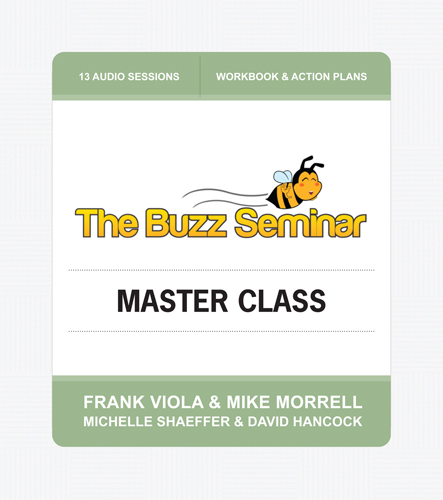
Frank Viola author is one of the facilitators of the new Buzz Seminar Master Class.

WHAT YOU GET WITH THE COURSE

It’s time for you to learn how to create BUZZ. For your blog. For your book. For your business. For your message and mission.

That’s why we converted our popular Buzz Seminar into a course (we call it “The Master Class”) that you can order from anywhere in the world and take from the comfort of your own home.

The BUZZ SEMINAR MASTER CLASS includes the following:

* You get 562 minutes of in-depth teaching from the four speakers (9.5 hours total).

* You get the teachings on an MP3 CD (which plays in most newer automobiles). You can upload the MP3 audios to your smart device or computer.

* You get the 120-page Buzz workbook (printed in a 3-ring binder) that supplements the audio teachings.

* The workbook is also included on the CD in PDF, Kindle, and Nook versions.

* You get a premium membership to the closed FaceBook group called THE HIVE where those who have attended the live seminar and/or taken the course help each other.

* You get access to our ever-growing Resource Page which keeps the course evergreen and up-to-date with the latest findings and resources.

* You also get the 100-page BUZZ BOOK as a free bonus supplement.

The Workbook Table of Contents & The Supplemental Audios on the CD

1. How to Use This Workbook to Your Benefit (Frank Viola & Mike Morrell)

Audio = 5 minutes.

2. How to Build Your Hive & Gain Traffic to Your Blog (Frank Viola)

Audio = 1 hour, 2 minutes.

3. Cheat Sheet: 43 Hard-Won Tips for Bloggers (Frank Viola)

Audio = 14 minutes.

4. Finding Your Unique Blog Profit Path – How to Monetize Your Blog in Ways That Actually Work (Michelle Shaeffer)

Audio = 49 minutes.

5. How to Drive Massive Traffic to Your Blog & The Psychology of Sharing Your Content (Michelle Shaeffer)

Audio = 56 minutes.

6. How to Spread Your Honey & Pollen Wherein Your Blog Posts Go Viral (Frank Viola)

Audio = 1 hour, 6 minutes.

7. How to Write a Great Book – The Three Methods I Use That Work for Anyone (Frank Viola)

Audio = 44 minutes.

8. Cross Pollination & Movement-Based Marketing (Mike Morrell)

Audio = 22 minutes.

9. Your Publishing Options & How You Can Get Published Now (Mike Morrell & Dave Hancock)

Audio = 45 minutes.

10. How to Hit a Best-Seller List – The Step-by-Step Process (Frank Viola & Dave Hancock)

Audio = 43 minutes.

11. Guerrilla Marketing – How to Get Your Message to the Masses (Dave Hancock)

Audio = 57 minutes.

12. The Entrepreneurial Author & How You Can Be One (Dave Hancock)

Audio = 52 minutes.

13. Questions and Answers (Panel of All Four Speakers)

Audio = 47 minutes.

14. Putting It All Together (Mike Morrell)

15. The Next Step – An Invitation to THE HIVE Closed FaceBook Group (Free for Course Members)

Appendix: An Inside Look at the World of Honeybees (Mike Morrell)

COURSE BENEFITS

* You have the course for your entire lifetime.

* You always have access to the special online Resource Page. It never expires. So every time it’s updated, you still have access.

* You can work through the course at your own pace! There’s no time-limits on the course lessons.

* You can put the audios on the device of your choice. Just copy the files from the MP3 CD to your device.

* You have lifetime access to THE HIVE (the closed FaceBook group). It never expires.

WHAT YOU’RE UP AGAINST

  • There are over 300 million blogs on the Web today, all vying for people’s limited attention.
  • There are over 3 million books published each year in the USA.
  • The average book in the USA sells less than 250 copies per year.
  • The average book in the USA sells less than 3,000 copies over its lifetime.
  • A book has less than a 1% chance of being stocked in an average bookstore.
  • For every available bookstore shelf space, there are 100 to 1,000 or more titles competing for that shelf space.

Point: It is increasingly difficult to make any blog or book stand out today. New titles are not just competing with three million recently published books, they are also competing with more than seven million other books available for sale.

The Buzz Master Class is designed to help you beat these odds . . . because the presenter’s have done it themselves with their blogs and books.

CONQUER ONLINE OBSCURITY – STOP BEING AN INVISIBLE BLOGGER & AUTHOR!

Suppose you enrolled in college or a trade school to learn a new skill. You would spend thousands of dollars on your education, it would take years to complete, and when you graduated, there would be no guarantee that someone would hire you.

Now imagine that you took a premium course at your own pace that would equip you to begin earning money immediately through your writing talent.

The course wouldn’t cost you anywhere near the cost of a college or trade school education. Nor would it take you years to acquire the strategies that you need to earn income.

This is what The Buzz Master Class is all about.

THE COURSE CLOSES OCTOBER 2ND AT 8:00 AM EST & THE PRICE GOES UP THE NEXT TIME IT’S AVAILABLE AGAIN

We have limited supplies of the course. So you’ll want to order soon!

Don’t wait. Your life deserves better and so do the people who need your message.

Remember, your results won’t change unless you take action and do something different.

The Buzz Seminar Master Class gives you the direction, the instruction, and the tools to bring forth the transformation that you are wanting.

We will stop taking orders on October 2nd at 8:00 AM EST and then the course will be wait-listed.

Remember: The next time we launch the course, which will be in a several months, the price will go up.

The current introductory price is only $697 USD plus shipping and handling. All courses will be shipped PRIORITY MAIL.

Read the rest of the article

buzz-small

The Man in the Glory

There’s a Man in the glory
Whose Life is for me.
He’s pure and He’s holy,
Triumphant and free.
He’s wise and He’s loving,
How tender is He!
His Life in the glory,
My life must be;
His Life in the glory,
My life must be.
There’s a Man in the glory
Whose life is for me.
He overcame Satan;
From bondage He’s free.
In Life He is reigning;
How kingly is He!
His Life in the glory,
My life must be;
His Life in the glory,
My life must be.
There’s a Man in the glory
Whose Life is for me.
In Him is no sickness;
No weakness has He.
He’s strong and in vigor,
How buoyant is He!
His Life in the glory
My life may be;
His Life in the glory,
My life may be.
There’s a Man in the glory
Whose Life is for me.
His peace is abiding;
How patient is He!
He’s joyful and radiant,
Expecting to see
His Life in the glory
Lived out in me;
His Life in the glory
Lived out in me.

—Mary E. McDonough, 1787

A Woman in Labor

The Lord used a parable once about a woman who was in labor. Consider this woman. She is pregnant. She must acquire a new wardrobe. It matters not what she wears, she still feels fat. The curves have vanished. Now there are stretch marks. It doesn’t matter how she sits, she still can’t get comfortable. She can’t even wear her two-piece for the summer.

And then comes the labor. I have no idea how cataclysmic the pain must be. But I have heard the screams firsthand. Talk about darkness! Talk about pain! Talk about suffering!

But what did the Lord say about it? When the woman completes her travail and the baby is born, she remembers her pain no more. She forgets everything—even the nasty things that came out of her mouth while she was screaming. The memory is erased because a new child is born into the world, and the morning has come. The night is forgotten.

The disciples forgot this when their Lord was taken away from them. They experienced the dark night. Those three days must have seemed like an eternity for them. There was no hope on the horizon.

Remember the parable of the old wineskin and the new wineskin? God will take away the old wineskin because it can’t contain the new wine. He needs a new wineskin, in fact. So the Lord tampers with our wineskins. He wrecks them if He wishes. He destroys the old wineskin so that He can hand us a new wineskin. That is why there are changes in church life. The Lord wants to deposit new wine. And the new wine is always better than the old wine.

This is the way in which our Lord works. First darkness, then light. First evening, then morning. First death, then life.

From Revise Us Again by Frank Viola, author

What you and I call the end of the day, God calls the beginning.

When you walk into your dark night, just remember: “This too shall pass.”

The Semantics of God’s Presence

Some Christians have a way of overstating their experiences. Others understate them. Multiple people may experience the exact same phenomenon—whether it be a church meeting, a conference, a retreat, a convention, a particular manifestation of the Holy Spirit, or a shared encounter.

One person may describe it as “unbelievable!” … “incredible!” … “awesome!” … “beyond description!” Another may describe it as “refreshing” … enjoyable” … “encouraging” … “delightful.” Still another may describe it as “good” … “fine” … “a blessing.”

Point: People often use very different vocabulary to express the exact same thing. For instance, Watchman Nee used a unique phrase when he referred to his fellowship with the Lord. He called it “touching the Lord.” Others use the phrase “sweet communion.” Others use “divine encounter.” Others use less phenomenological phrases.

To describe fixing one’s heart upon the Lord, some people use the phrase “turning to the Lord.” Others use the word “gazing.” Others say “beholding” or “looking into the face of God.” Still others say “contemplating,” “centering,” “abiding,” or “partaking.” Others describe it as “meditating.”

By and large, it’s semantics.

I’ve observed this phenomenon all my Christian life. People express the same experiences differently. This is due to many varied factors. Some of which are the person’s temperament, the specific vocabulary that is used in one’s religious tradition, or a specific “effect” they wish to have on those who hear them testify. (Sometimes this isn’t so well motivated.)

In addition, to say that a Christian is to “seek” a feeling of God’s presence is bad theology. Plain and simple. There’s no such exhortation in all of Scripture. Try to find it in the New Testament, and you will discover that it’s glaringly absent. It’s just not there.

An oft-quoted passage used to support the idea of seeking God’s felt-presence is Psalm 22:3. In the King James Version, it reads, “Thou [God] that inhabitest the praises of Israel.” This text has been traditionally used to invoke or summon God’s presence by singing praise and worship songs.

Strikingly, except for the KJV, the New Jerusalem Bible, and the New Century Version, most other versions take a different view of the translation. For instance, the Revised English Bible translates it this way: “You, the praise of Israel, are enthroned in the sanctuary.”

The New American Bible takes the same approach: “Yet you are enthroned in the holy place, O glory of Israel.” The New International Version does likewise: “Yet you are enthroned as the Holy One; you are the praise of Israel.” The New Living Translation translates it as follows: “Yet you are holy, enthroned on the praises of Israel.”

The term praise here is seen as a reference to the One who Israel praises. The text is an affirmation of an Old Testament reality. Simply put, the presence of God dwells in the holy of holies in the temple at Jerusalem. It in no way indicates that God is somehow made present by our praises.

According to the scholars who have translated this passage in the above versions (1) the text must be understood in the context of Old Testament temple worship; and (2) it is God Himself in His presence in the temple who is called “the Praise (or Glory) of Israel.”

What’s more, we must be cautious about literally applying statements about Old Testament temple worship to Christian worship. Consider the implications of Jesus’ words in John 4 in this regard.

Believe me, woman, a time is coming when you will worship the Father neither on this mountain nor in Jerusalem.… Yet a time is coming and has now come when the true worshipers will worship the Father in spirit and truth, for they are the kind of worshipers the Father seeks. God is spirit, and his worshipers must worship in spirit and in truth. (John 4:21, 23–24)

Worship of the living God can occur at any place and at any time.

From Revise Us Again by Frank Viola, author

The Pragmatic Spiritual Conversational Style

Unlike the Charismatic Spiritual Conversational Style (SCS) and the Quoter SCS, the Pragmatic SCS is chiefly interested in what works. Those who use this style of conversation have a nuts-and-bolts approach to life. Appeals to personal revelation do not impress them. Neither do quotes from the Bible. They want to see what is working and what has proven to be successful in the lives of the people with whom they converse. This, they believe, is where truth lies.

Those who hold to the Pragmatic SCS believe that there are no easy answers to the countless theological questions that have raged in the church for the last seventeen centuries. Rather than quibbling about “correct doctrine,” the Pragmatic SCS focuses his or her sights on what is working in the real world. With this in mind, the Pragmatic SCS is concerned less with academic differences and centers more on actual practice. Pragmatics are willing to “agree to disagree” over theological matters.

Of course, this approach does not sit well with those who are less charitable and more militant in spirit, insisting upon resolving their differences “for the sake of the truth.” While this sounds noble, it more often than not actually tends toward division and harsh feelings. Nevertheless, the Pragmatic SCS is always pressing the question “How has this truth worked in your life, in your church, etc.?”

Those who do not use the Pragmatic SCS feel uncomfortable with this approach. They believe that such a rearrangement of the conversational furniture betrays the authority of Scripture. Since the Pragmatic style is more concerned with outward effects, it pays less attention to doctrinal precision. Hence, when a Quoter cites a text from Matthew, the Pragmatic isn’t satisfied. He or she wants to know “How does this work out in real life?” Their conviction is that evaluating the practical outworking of a given belief is much richer than merely quoting a biblical text and less likely to short out the conversation.

Those who use different stylistic conventions argue that the Pragmatic approach rests upon shaky ground as a basis for one’s beliefs. They feel that just because a belief may appear to have practical utility, that doesn’t mean it’s valid or divinely approved. Thus when Quoters and Pragmatics have conversations, both seek to cajole each other into rearranging the boundaries of the conversation so that the other person is conversing according to their playbook. This is largely true with the Charismatic as well, for if God hasn’t spoken something directly to his or her conversational partner, the Charismatic is apt to reject it, regardless of its practical utility or biblical merit.

It must be stressed at this point that not all who hold to the Pragmatic SCS work with the same premise. For some Pragmatics, the notion of success is a self-evident idea that’s measured by outward metrics like numbers, size, budget, attendance, conversions, etc. For others, the concept of success lies in following Christ and being conformed to His image. However, because of the strong appeal to success and workability, these two versions of the Pragmatic SCS are often indistinguishable by other SCSs.

From Revise Us Again by Frank Viola, author

In Quest for a City

      God called Abraham out of the land of Babylon to a city that the Living God Himself had built. En. Ur of the Chaldeas is the land that later came to be called Babylon. When the Divine call came to Abraham, he dropped everything, left Babylon, and began his search for the city of God. Hebrews 12:8-10.

      Abraham topped a hill, put his hand above his eyes, looked down into the valley, and looked for the city that God had built. This became his occupation in life. Countless were the hills that he topped and the valleys that he looked down upon. He did this until the day he died.

      As Christians, Abraham is our father. And the city that he looked for represents the church after God’s own heart—our native habitat. Thus the call to Abraham extends to us as well.

      So if you, like Abraham, would like to begin the quest for the church after God’s own heart, I would like to recommend these books that will help you further in the journey.

by Frank Viola, author

Apostleitis

    I wish to introduce you to one last disease. This particular illness doesn’t inflict entire churches. Those who are at risk are typically young males who are ambitious to serve God. The disease? Apostleitis.

      Apostleitis is the unrealistic desire to become an apostle. Those who suffer from this disease have no idea what the apostolic call involves, for if they did, they would never dream of wanting such a call.

      The apostolic calling is a death sentence. It’s one of the worse things to befall an individual. See 1 Corinthians 4:9-13; 2 Corinthians 1:8-10; 4:1-12; 6:3-10; 11:1-12:10. One of the best treatments for those who are plagued by this disease is to read a book entitled, The Release of the Spirit by Watchman Nee. That volume has a rather high cure rate for healing this illness. The book is made up of talks that Nee had with young apostolic workers who he was training.  

      It’s far wiser to prevent an illness than to cure one after contracting it. What follows, therefore, are three ingredients for building a healthy immune system. Each outlines a long term regimen for good health. 

      * Eating the right food. The church must learn how to draw its life and energy from nothing but Jesus Christ, John 6:57. If a church doesn’t know how to do this, it will not survive. It must learn to nourish itself with those things which are invisible and intangible. In addition, it must receive a balanced meal. The riches of Christ are infinite in scope. If a church partakes of only one or two aspects of Him, it will become undernourished and deformed. 

      * Regular exercise. Nourishing oneself with spiritual food is not enough. The church must share its spiritual food with its members. That is, the members must function in the meetings. They must learn to partake of Christ individually and together, and then impart His life to the other members in the gathering. Such spiritual functioning is the life-blood of a church.

      Christians in the West have been so conditioned to be passive that they don’t know how to function in a meeting where there is no human officiation. Like Pavlov’s dog, many (if not most) believers have been conditioned to be quiet and watch someone else minister.

      God has provided a remedy for this. He has set some in the church to equip the saints for the work of spiritual ministry and to bring the church unto full stature. Properly conceived, these equipping ministries teach the church how to build itself up in love. Ephesians 4:11-16. 

      * Obtain a health practitioner. In the first century, itinerant workers were given to the church by God to show the Lord’s people how to draw their supply from Christ. They existed to help churches spot those spiritual maladies to which they were blinded. They also showed them how to ward off spiritual disease. If a church was suffering from a sickness, they treated it.

      All of Paul’s epistles, for example, were provoked by church problems. Like a fine surgeon, Paul’s letters were the Divine instruments by which God effected their healing. Christian workers, therefore, are servants to the Body of Christ. They function as health-care practitioners, acting as nurses, doctors, nutritionists, and sometimes surgeons. (Paul actually uses the metaphor of a nurse to describe his function in the life of the churches he served.) 1 Thessalonians 2:7. 

      Understanding church pathology is vital for the sustained health of an organic church. Yet there’s also the danger of becoming a spiritual hypochondriac. Continuous introspection is a sign of sickness. It prevents action. So don’t make a ritual out of checking for spiritual disease. The paralysis of self-analysis can end up killing a church also.

       If you belong to a non-traditional church, I recommend that the members come together once a year or so to take its temperature, check its pulse, and detect its vital signs. In this way, this chapter will be translated from bloodless theory into practical help . . . help that just may save the life of your church.